
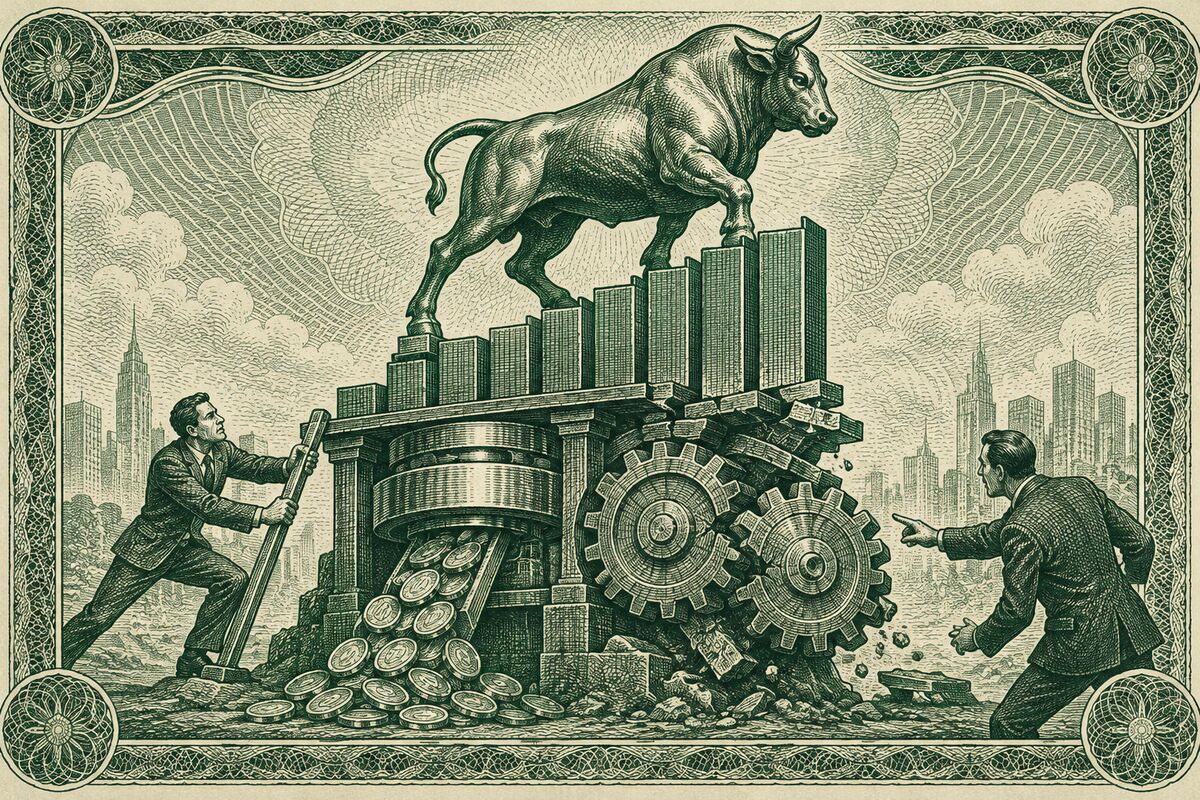
Paul Tudor Jones's warning for 2027 is about supply and demand for shares. Buybacks and takeovers take shares off the market; initial public offerings, secondary offerings and the end of insider lock-ups put shares back on. When the supply of new stock outruns the buying, prices can fall even if company profits hold up. That is the "flow picture" Jones called the most negative "since 2002" on CNBC on October 13, 2026, as large AI companies prepare to raise money. This follow-up to our report on Jones's 2027 warning explains how share supply works, with real figures from one company's filings and the arithmetic shown.
Why the number of shares matters
A stock market is an auction. Investors with cash bid for a fixed pool of shares, and the price settles where buyers and sellers meet. Change the size of the pool and you change the price, all else equal.
Three things shrink the pool. Companies buy back their own stock and cancel it. Acquirers buy whole companies for cash, removing their shares from the market. Companies also go private. Three things grow it: new listings, follow-on share sales by listed companies, and shares issued to employees or to fund acquisitions.
For most of the past four years, Jones argued, the shrinking forces won. His concern is that they are about to lose.
What Jones said about supply
In the CNBC interview, Jones pointed to large AI companies coming to market, naming Anthropic and OpenAI as well as a just-completed SpaceX offering, and said he expects more secondary offerings to fund the AI buildout. He drew a direct line to the turn of the century:
"You had all this issuance, all these IPOs in '98 and '99, and really 2000, 2001, 2002. Those were the easiest years to be short because you kept having these unlocks that just kept adding supply to the market."
The "unlocks" are the expiry of lock-up agreements. When a company goes public, insiders and early investors usually agree not to sell for a set period, often several months, set in the underwriting agreement. When it ends, a large block of shares becomes free to trade. That can hit the price of the newly listed company, and the money those holders raise competes with the rest of the market for attention.
How buybacks shrink supply: a real example
Cisco Systems ($CSCO) shows the mechanics in its own numbers. In its fiscal year ended July 25, 2026, Cisco spent $6.11 billion buying back shares, according to its annual report. Its average diluted share count fell from 4.062 billion in fiscal 2024 to 3.987 billion in fiscal 2026, a 1.8% reduction over two years.
That reduction lifts earnings per share without any change in profit. Take fiscal 2026 net income of $13.27 billion:
- Divided by 4.062 billion shares: $3.27 a share.
- Divided by 3.987 billion shares: $3.33 a share.
The same profit spread over fewer shares produced about 1.9% more earnings per share. Multiply that effect across the many large companies that buy back stock every year and you get one of the quiet supports Jones described. Our look at Cisco's dividend and buyback math works through where that money comes from.
How new issuance adds supply: the arithmetic
A new listing works in the opposite direction. Consider a hypothetical company that goes public selling $10 billion of stock. The buyers' $10 billion has to come from somewhere: new savings, cash on the sidelines, or the sale of other stocks.
If even part of it comes from selling existing holdings, those shares face extra selling pressure. Six months later, if insiders whose shares are worth another $20 billion become free to sell, the market has to absorb that too. Repeat across several large offerings in one year, and the market needs a steady stream of fresh money just to hold its level.
The numbers in that example are illustrative. The mechanism is not. Finnhub's IPO calendar lists 26 initial public offerings priced in September and October 2026, before any of the largest AI listings Jones mentioned.
Why it bites hardest in a narrow market
Supply matters most when buying is concentrated in a few stocks. When much of the market's gain comes from a small group of AI-linked companies, new AI shares compete directly with the existing leaders for the same investors. A fund manager who buys a new AI listing may pay for it by trimming an older one.
That is one reading of the late-October sell-off. From October 13 to November 2, 2026, the technology-heavy Invesco QQQ Trust ($QQQ) fell 8.4%, from $743.57 to $681.09, while the SPDR S&P 500 ETF ($SPY) fell 3.3%, from $778.01 to $752.10, according to Nasdaq.com closing prices. The pressure was concentrated where Jones expects new supply to land.
How to watch the supply picture yourself
- IPO calendars. Exchanges and financial sites publish upcoming offerings with expected size and date.
- Lock-up expiry dates. The IPO prospectus states the lock-up terms, so you can count forward from the listing date.
- Follow-on offerings. Companies announce them in press releases and SEC filings.
- Buyback totals. Companies report repurchases in each quarterly filing. A falling total across many large companies would confirm part of Jones's case.
None of these tells you what the market will do. Together they show whether the balance Jones is worried about is tipping. For more context, see our coverage in Markets and practical steps in what to do about Jones's 2027 warning, or return to the front page.
FAQ
What does "flow picture" mean?
It describes the balance of money moving into and out of stocks, including buybacks, takeovers, new offerings and fund flows. Jones called the current balance the most negative since 2002.
Why do IPOs affect the rest of the market?
Money spent on new shares has to come from somewhere, often from selling existing holdings. Large offerings, and later the release of insiders' shares, add supply the market has to absorb.
Do buybacks really raise stock prices?
They reduce the share count and lift earnings per share. Cisco's 1.8% share reduction over two years raised earnings per share by about 1.9% on the same profit. They also add a steady buyer to the market.
What is an IPO lock-up?
An agreement in which insiders and early investors promise not to sell shares for a set period after a company lists. When it expires, those shares can be sold.