
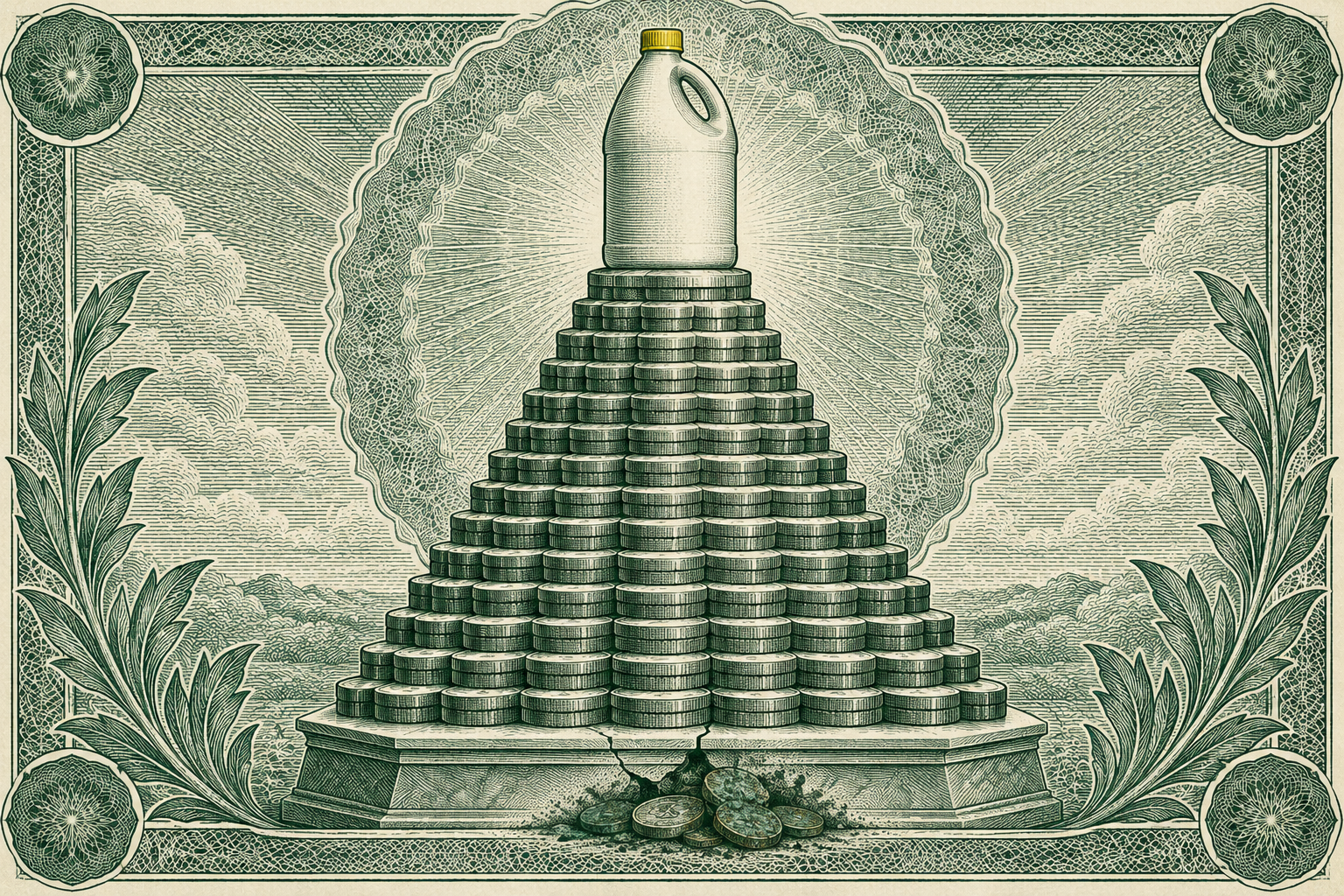
Yes. Clorox ($CLX) is a Dividend Aristocrat. The S&P 500 Dividend Aristocrats index admits only companies that have raised their dividend for at least 25 consecutive years, and Clorox has done it for close to five decades. Its most recent raise, announced July 31, 2026, lifted the quarterly dividend from $1.24 to $1.25 per share, payable August 28, 2026 to holders of record on August 12, according to Clorox's own announcement. At the October 15 share price of $84.97, that works out to a yield of about 5.9%. The title is real. The question a conservative investor should actually ask is whether the dividend is as safe as the streak makes it look.
How long is the streak, exactly?
Here the sources disagree by a year or two, and it is worth knowing why. Clorox's July 2026 release describes "a long history of providing value to its shareholders through regular dividend payments" but does not print a number. A Motley Fool analysis from May 2026 counted the summer 2025 raise as the 48th consecutive annual increase, which would make the July 2026 raise the 49th and put Clorox one raise away from Dividend King status (50 years) in 2027. Third-party dividend trackers list anywhere from 42 to 50 years depending on how they count the first increase. For a reader deciding whether the company qualifies as an Aristocrat, the discrepancy does not matter: every count clears the 25-year bar by a wide margin.
What the dividend pays today, with the arithmetic
All figures below are from Financial Modeling Prep market data, retrieved October 15, 2026, and the calculations are shown so you can redo them with tomorrow's price.
- Quarterly dividend: $1.25. Annual rate: 4 x $1.25 = $5.00 per share.
- Share price (October 15, 2026): $84.97. Forward yield: $5.00 / $84.97 = 5.88%.
- Next ex-dividend date: October 28, 2026, at $1.25 per share.
- 52-week range: $79.12 to $128.90. The stock is down 15.7% in 2026 and 28.2% over twelve months.
- Dividends paid per calendar year: $4.04 (2019), $4.34 (2020), $4.54 (2021), $4.68 (2022), $4.76 (2023), $4.84 (2024), $4.92 (2025). That is a 21.8% increase over six years, or roughly 3.3% a year compounded.
Notice what the yield is telling you. A 5.9% yield on a household-products company is unusually high, and most of it comes from the share price falling, not the dividend rising. Within the past twelve months the same dividend was attached to a stock trading near $129, the top of its 52-week range. A high yield that arrives through a falling price is a warning, not a gift.
The catch: the payout ratio
On trailing twelve-month figures, Clorox is paying out about 103% of its earnings as dividends (payout ratio of 1.03 per Financial Modeling Prep market data, retrieved October 15, 2026). In plain terms, over the past year the company paid shareholders slightly more than it earned. That is survivable for a while, because dividends are paid from cash rather than from accounting earnings, and Clorox has a steady cash business. But it leaves no cushion. The Motley Fool piece linked above makes the same point from the other direction: unless earnings and free cash flow recover, the dividend expense becomes hard to keep raising.
The next data point is close. Clorox reports fiscal first-quarter results on November 2, 2026, with analysts expecting $1.08 per share. Last quarter, reported August 3, the company earned $1.66 against a $1.64 estimate. A reader who owns the stock for the dividend should read that report for one number first: operating cash flow against the roughly $600 million a year the dividend now costs (a $10.3 billion market value at $84.97 implies about 121 million shares; times $5.00 is about $605 million; the exact share count is in the 10-Q).
Aristocrat versus King versus "high yield": which label matters?
A Dividend Aristocrat is an S&P 500 member with 25 or more consecutive annual increases. A Dividend King has 50 or more; it is an informal label, not an index. Neither label says anything about the size of the yield or the safety of the next payment. They record the past. Clorox's streak tells you management has treated the dividend as a promise through recessions, a pandemic demand spike and the hangover that followed it. It does not tell you the promise is cheap to keep in 2027.
A common mistake: buying the streak instead of the business
Investors who screen for Aristocrats often buy the longest streak with the highest yield. That screen would have put Clorox near the top of the list for the past year, during which the shares fell by more than a quarter. The dividend income did not come close to covering the capital loss. The conservative approach is the reverse: start with the cash flow, ask whether it covers the dividend with room to spare, and treat the streak as a tiebreaker. Our Dividends section applies that test to a different payer most weeks.
A five-point checklist before buying Clorox for the dividend
- Payout ratio under 80% of earnings, or free cash flow covering the dividend by at least 1.2 times. Clorox is above 100% on earnings today.
- A yield that is high because the dividend grew, not because the price collapsed. Check the five-year price change (Clorox: -47.9%).
- A next-earnings date on the calendar, so you know when the thesis gets tested (November 2, 2026).
- Debt that is not rising to fund the payout. Read the balance sheet in the 10-Q, not a summary.
- An honest view of what you would do if the raise stops. A frozen dividend is not a cut, but the market usually prices it like one.
For the macro backdrop behind consumer-staples margins, see our latest on the hot September CPI print, and the day's full coverage on the Wall Street Conservative front page.
FAQ
Has Clorox been a Dividend Aristocrat for long?
Yes. Its streak of annual increases is close to 50 years, far beyond the 25 needed for the index. The exact count varies by source because they date the first increase differently.
What is Clorox's dividend yield right now?
About 5.9%: $5.00 of annual dividends divided by the October 15, 2026 price of $84.97. The yield changes with the price every day.
When is the next Clorox dividend?
The next ex-dividend date in the data is October 28, 2026, for $1.25 per share. Confirm the payment date in the company's declaration.
Is the Clorox dividend safe?
It is currently larger than trailing earnings, which is the main risk. Whether it stays safe depends on cash flow recovering; the November 2 report is the next test.
Could Clorox become a Dividend King?
If the 2026 raise was the 49th in a row, as one count suggests, a raise in 2027 would make it 50 and earn the informal Dividend King label.