
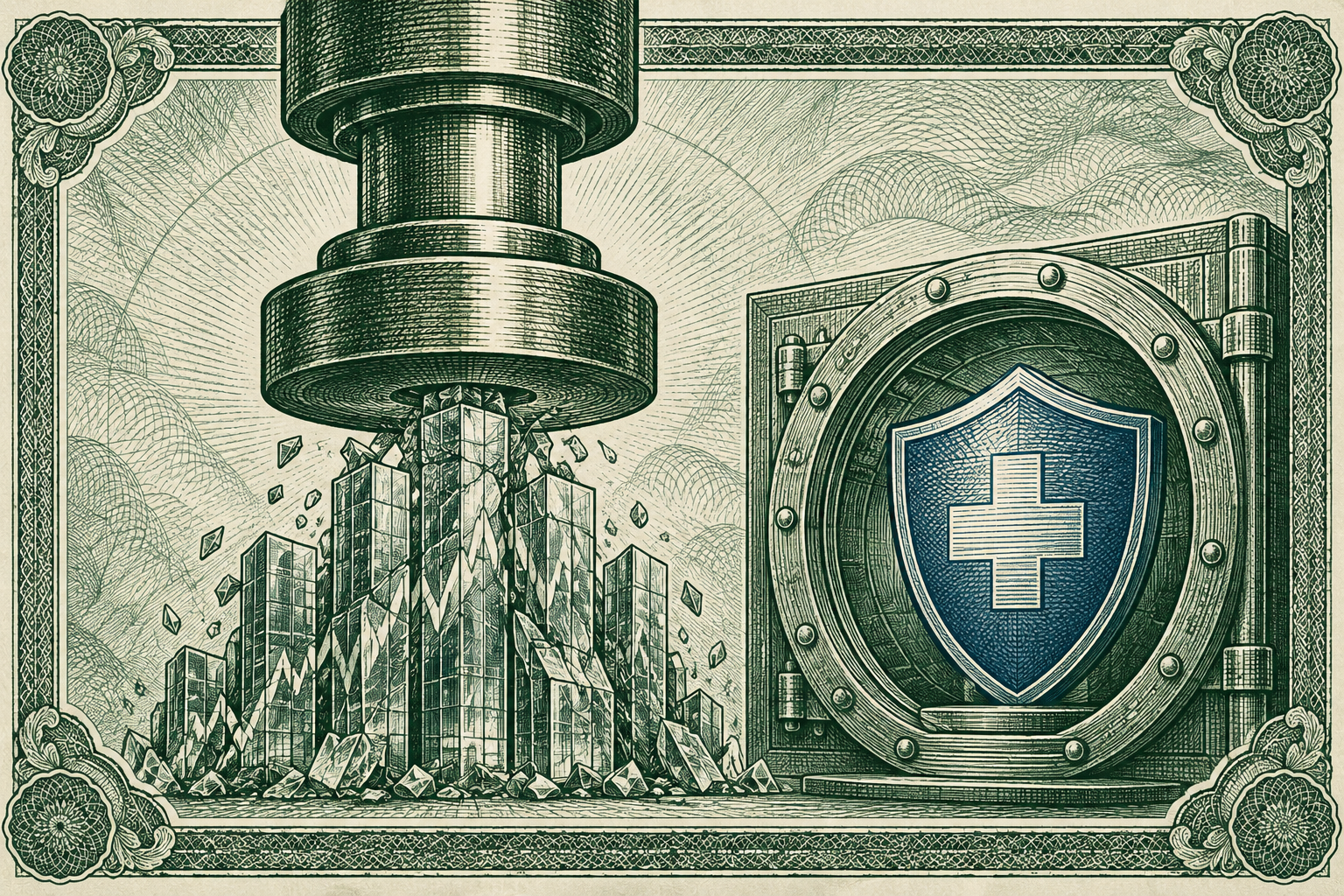
When Treasury yields climb toward levels not seen in decades, the stock market’s most ambitious stories can begin to look less persuasive. The arithmetic of valuation changes, and richly priced growth stocks must compete with a more attractive alternative: income from government debt.
That backdrop could give defensive companies such as UnitedHealth Group a sturdier role in the US market. It is not a promise of outperformance, and it does not make healthcare shares immune to volatility. But as traders reassess speculative growth and AI-linked equities, earnings stability and dividend support may become more valuable qualities.
The discount-rate problem for growth stocks
The central issue is not simply that higher yields offer investors another place to put capital. Treasury yields also influence the discount rate used to value future corporate cash flows. When that rate rises, cash flows expected far into the future become less valuable in today’s valuation.
That mechanism can be especially uncomfortable for companies whose appeal depends on rapid expansion, distant earnings, or a premium valuation. The higher the discount rate, the more difficult it may be to justify paying an elevated price for projected growth. In that setting, even a company with an exciting narrative can face a tougher market test.
AI-linked equities and other speculative-growth trades are particularly exposed to changes in investor patience. When yields are low, markets may be more willing to pay for distant possibilities. When yields rise, the conversation can shift toward current earnings, cash generation, and shareholder distributions.
Why UnitedHealth enters the conversation
UnitedHealth Group, listed on the New York Stock Exchange under $UNH, is among the defensive dividend stocks highlighted as potentially better positioned than growth equities in a higher-rate environment. The appeal is less about a dramatic catalyst than about portfolio ballast: healthcare demand and established operations may offer a different earnings profile from companies whose valuations depend heavily on future expansion.
A defensive strategy, as outlined in Coinlyt’s commentary on investing through difficult conditions, focuses on qualities such as steadier businesses, cash generation, and dividends. Those features do not eliminate risk. They can, however, give investors a framework for evaluating whether a company’s value is supported by ongoing business performance rather than by an increasingly distant forecast.
The case for $UNH therefore rests on relative appeal. If higher yields make speculative growth harder to value, a company associated with defensive healthcare characteristics may draw greater attention. Dividend support could also matter psychologically and financially when markets become less willing to reward long-duration growth.
A potential rotation, not a one-way trade
Market rotations rarely move in a straight line. Rising yields can pressure growth valuations, but healthcare companies still face their own operational, regulatory, and company-specific uncertainties. UnitedHealth should not be treated as insulated from a broad market selloff or from developments affecting its business.
The source material on defensive dividend stocks places $UNH within a broader group of companies that could hold up better as Treasury yields rise. That framing is important: defensive positioning is a potential hedge against a difficult environment, not a guaranteed trading outcome.
For traders, the signal is the changing relative value between expensive future growth and established cash-generating businesses. For longer-term investors, the question is whether earnings stability and dividend support can provide enough foundation when valuation multiples come under pressure. If volatility continues in the AI and speculative-growth trade, healthcare and other steady earners may become more prominent in the market’s rotation.
The broader lesson is pragmatic. Higher Treasury yields can redraw the map of what investors are willing to pay for uncertainty. As described in Simply Wall St’s discussion of defensive dividend stocks, UnitedHealth may benefit from that change in preference—but its defensive label is a relative description, not a shield against risk.
Bull/Bear Verdict
Bull Case: If higher Treasury yields continue to pressure richly valued growth and AI-linked equities, $UNH could benefit from greater investor interest in healthcare, earnings stability, and dividend support.
Bear Case: Rising yields can weigh on broad equity valuations, while $UNH remains exposed to company-specific and healthcare-sector risks, so its defensive profile may not prevent volatility.