
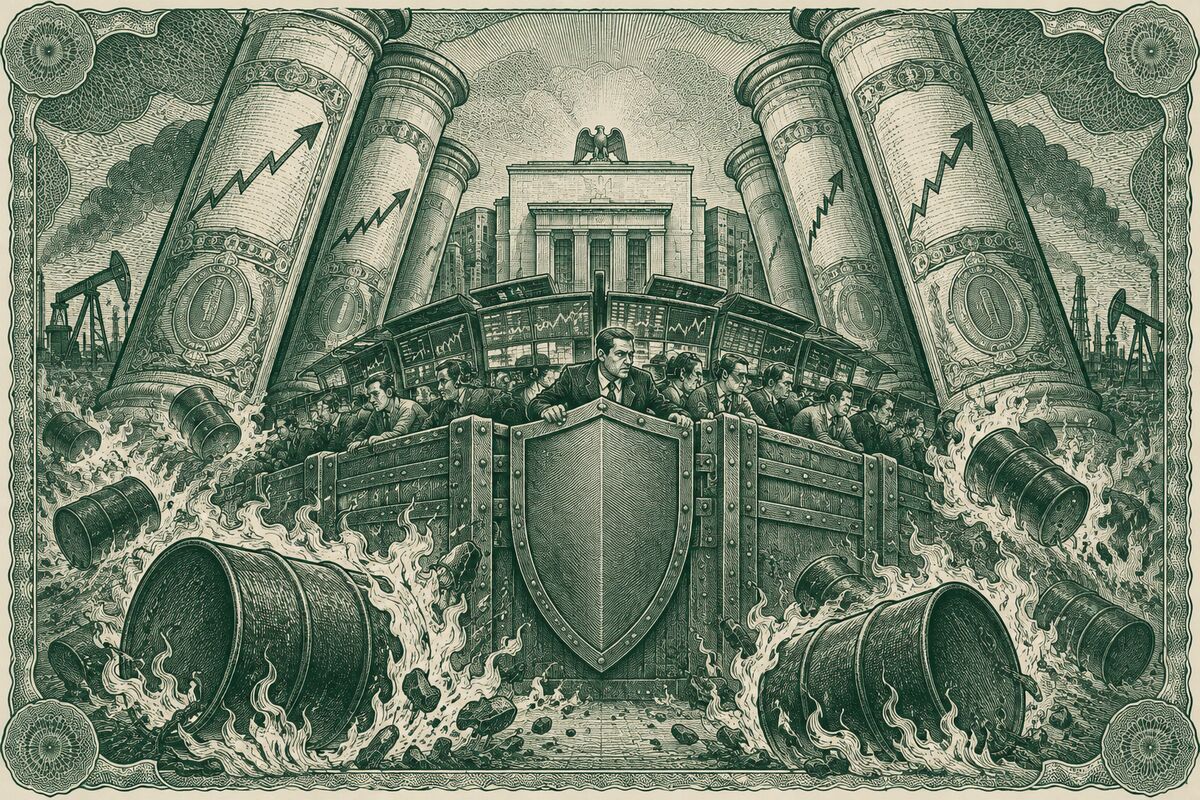
Wall Street is being reminded of an old market rule: inflation shocks do not need to become permanent to damage equity valuations. The S&P 500 and Dow Jones declined after oil prices spiked when Trump rejected an Iran peace proposal, according to Reuters.
The immediate issue is not simply the direction of crude prices. It is the chain reaction: more expensive energy can complicate the inflation outlook, lift Treasury yields and increase the discount rate applied to future corporate cash flows. That combination puts traders on defensive footing precisely as markets are pricing roughly a 66% probability of a Federal Reserve rate hike in October.
Geopolitics Has Re-entered the Market Equation
Renewed uncertainty over Iran has added a geopolitical premium to oil. The United States and Iran are expected to hold separate talks with mediators on Monday or Tuesday, according to an official cited by Reuters. Until those discussions produce greater clarity, energy prices may remain highly sensitive to headlines and diplomatic developments.
That sensitivity matters for equities because oil is both an economic input and an inflation signal. A sustained increase in energy costs could raise transportation, manufacturing and household expenses. Even if the shock fades, investors may demand more evidence that inflation is moving lower before assigning higher valuations to stocks whose earnings are expected far in the future.
Higher Yields Tighten the Valuation Screw
Charles Schwab commentary said investors face a full slate of inflation and labor-market data, with stocks sliding early as oil prices and yields rose. The significance is straightforward: when Treasury yields climb, the discount rate used to value future cash flows also rises.
That mathematical adjustment tends to weigh most heavily on high-growth stocks. Their valuations often depend on earnings expected years ahead, making them more sensitive to changes in interest rates. A higher discount rate reduces the present value of those distant cash flows, even when a company’s operating outlook has not changed.
Rate-sensitive dividend payers face a different pressure. Their income characteristics may look less distinctive when government bond yields rise, while higher financing costs can challenge companies carrying substantial debt. The result is not necessarily a broad equity selloff, but it can produce sharper distinctions between businesses with resilient balance sheets and those dependent on cheap capital.
The Fed’s Inflation Problem
The Federal Reserve raised rates by 0.25 percentage points at its September meeting, bringing the target range to 3.75%-4.00% while citing elevated inflation. Markets are now weighing whether the oil shock could reinforce the case for another increase in October.
That decision will depend heavily on the incoming data. Inflation readings should show whether price pressures are broadening beyond energy, while labor-market figures will help determine whether demand remains strong enough to keep inflation elevated. A firm labor market alongside higher oil prices would present a more difficult policy mix than a temporary energy spike paired with cooling employment conditions.
Why Balance Sheets Matter Now
In this environment, conservative investors may favor companies with stronger balance sheets while awaiting clearer inflation and labor-market evidence. Lower leverage, dependable liquidity and less reliance on refinancing may provide greater resilience if yields remain elevated.
That preference is less about chasing a particular sector than about demanding financial durability. The market has less room for valuation excess when the risk-free rate is rising and geopolitical uncertainty is lifting input costs. High-growth shares may need stronger earnings delivery to offset the valuation drag, while dividend payers may need credible balance-sheet support to remain attractive relative to bonds.
The bottom line is clear: Wall Street is facing a two-front test. Oil prices are adding inflation risk, while Treasury yields are challenging the assumptions embedded in equity valuations. The S&P 500 and Dow Jones may remain headline-sensitive until Iran developments, inflation data and labor-market reports clarify whether this is a temporary shock or the beginning of a more persistent policy problem.
Bull/Bear Verdict
Bull Case: If US-Iran talks reduce oil-market uncertainty and incoming labor and inflation data cool, the pressure from higher yields and the roughly 66% October rate-hike probability may ease.
Bear Case: If elevated oil prices reinforce inflation while Treasury yields rise, the Fed’s 3.75%-4.00% target range could be followed by another hike, putting further pressure on high-growth and rate-sensitive equities.