
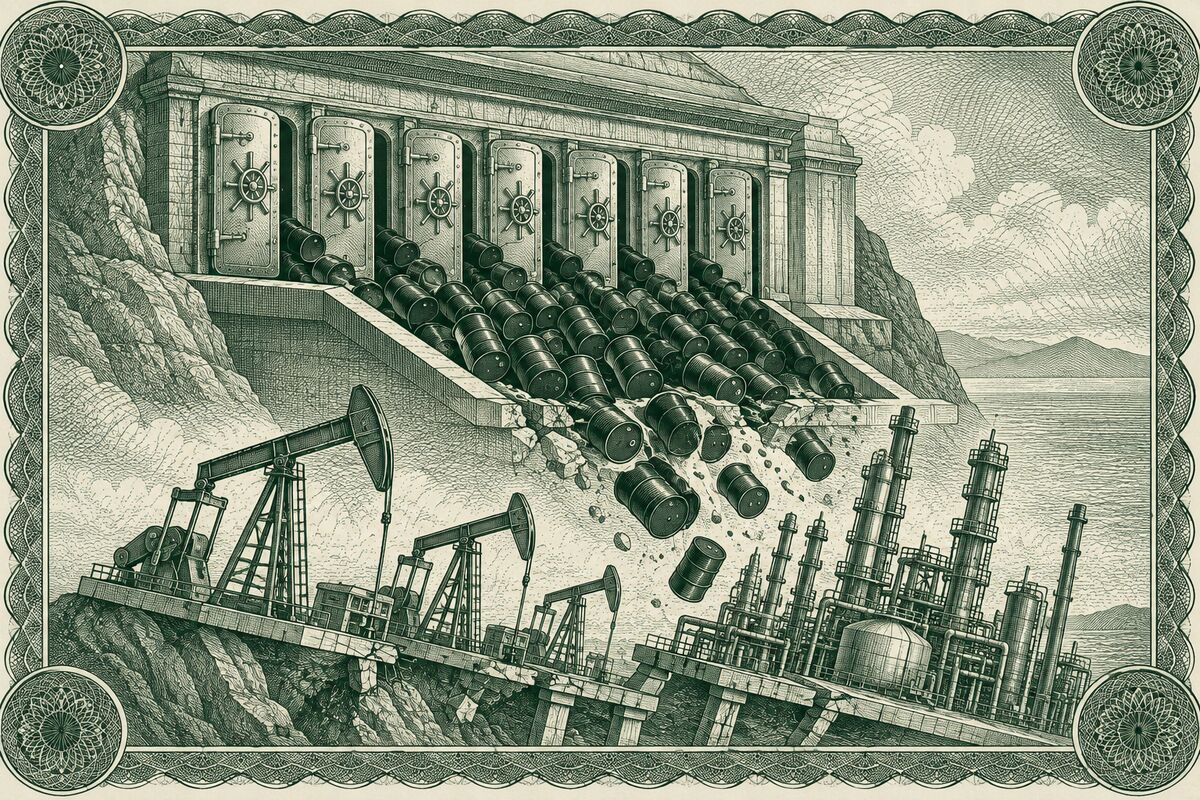
Oil markets were handed a fresh supply shock Friday as G7 countries agreed to release crude and diesel stocks, sending prices sharply lower and breaking below technical support. For North American markets, the move is more than a headline: it could cool inflationary pressure for households and businesses while tightening the spotlight on an energy sector that carries outsized weight in Canada.
The release also complicates the market’s response to Middle East tensions. Just as geopolitical risk had been capable of lifting crude-price expectations, the prospect of barrels arriving from strategic stockpiles has introduced a counterweight. The result is a market being asked to price both disruption and relief at the same time — a combustible mix for investors in US and Canadian energy equities.
According to Reuters reporting cited in the market coverage, G7 leaders confirmed a release of up to 100 million barrels after pressure from the United States. French President Emmanuel Macron said diesel and crude stocks would be released over four months, while President Trump said Europe had agreed to release a significant amount of stockpiles.
A new ceiling for crude?
The immediate reaction was unmistakably bearish. Oil moved sharply lower after the stockpile headlines, and technical support gave way as traders absorbed the scale and timing of the planned release. Technical analysts at InvestingLive also described crude as breaking below support as the news pressured prices.
That does not erase the supply risks connected to the Middle East. It does, however, create the possibility that official barrels could cap some of the gains that geopolitical tensions might otherwise generate in the near term. Markets may now treat each new escalation through a second lens: not only how much supply could be disrupted, but also how much emergency supply policymakers are willing to deploy.
The four-month timetable matters because it suggests the release is not merely a one-day announcement. Additional crude and diesel supply entering the market over time could weigh on pricing expectations, particularly if demand does not accelerate enough to absorb it. The stockpile action may therefore reshape the near-term balance between fear-driven buying and policy-driven supply relief.
Inflation relief, producer pressure
Lower crude prices could offer welcome breathing room for industrial and consumer companies. Energy is a direct input for transportation, manufacturing and logistics, and cheaper fuel may reduce some operating costs. It could also ease pressure on inflation, potentially helping consumers and businesses facing elevated energy bills.
But what looks like relief in one corner of the market can feel like gravity in another. North American energy producers may face a less supportive pricing backdrop if crude remains under pressure. Revenue expectations across the sector are closely linked to the commodity’s direction, so a sudden supply increase could make investors more cautious about the earnings outlook even without a company-specific event.
The tension is especially important in Canada, where the stock market has a heavy energy presence. A weaker crude market can therefore weigh more broadly on the Canadian market than it might on a more diversified index. The same development that lowers costs for fuel-consuming businesses may reduce the economic and market support provided by energy producers.
OPEC+ adds a separate complication
The G7 release should not be confused with another supply development: Reuters also reported that OPEC+ delayed its oil-capacity review after the Iran war disrupted expansion plans. The two developments are related because both affect expectations for future supply, but they point in different directions.
The G7 action is an immediate, coordinated release of existing stocks. The OPEC+ delay concerns a review of capacity and expansion plans disrupted by conflict. Together, they leave traders balancing near-term barrels against uncertainty about longer-term production potential. That uncertainty may keep crude volatile even as the stockpile release presses prices lower.
For North American markets, the message is blunt. Lower oil may help the wider economy through reduced input costs, but it can also remove a valuable tailwind from US and Canadian energy producers. The G7 has put a visible supply cushion beneath a market that had been watching geopolitical risk closely. Whether that cushion lasts will depend on the release’s implementation, the path of demand and the still-unsettled supply picture surrounding OPEC+.
Bull/Bear Verdict
Bull Case: The release of up to 100 million barrels over four months could ease crude-related inflation and reduce input costs for industrial and consumer companies, while limiting the economic damage from Middle East supply fears.
Bear Case: The sharp move below technical support suggests near-term pressure for energy producers, and Canada’s energy-heavy market composition could amplify the impact if added G7 supply caps crude-price gains.