
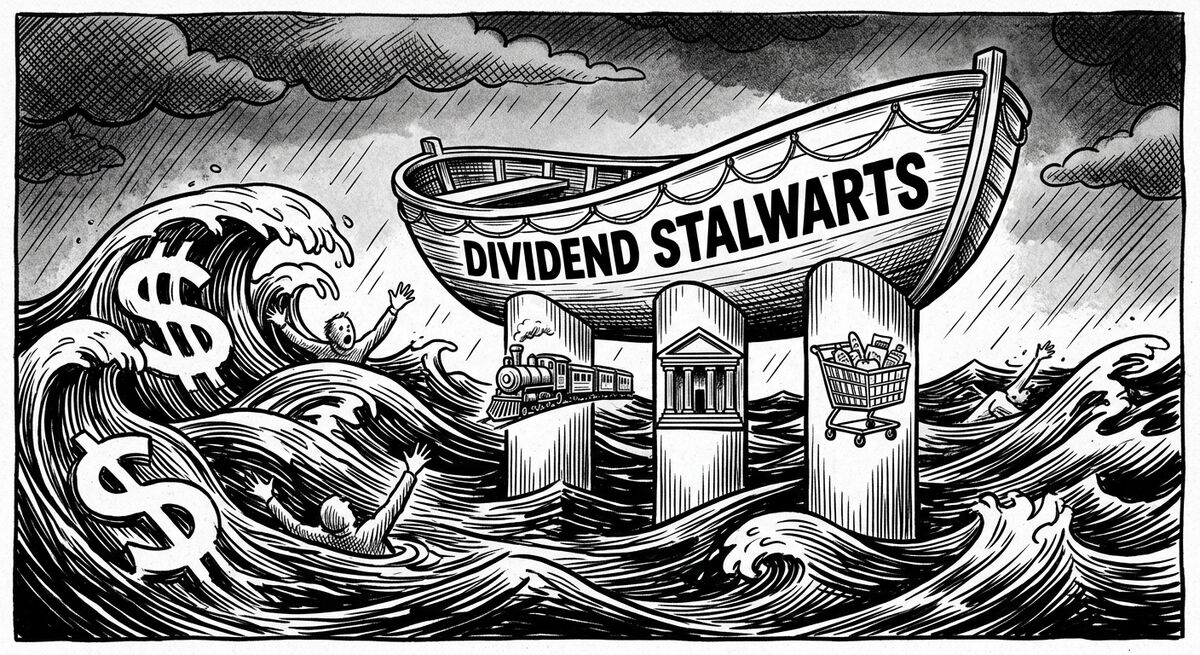
In today's turbulent market landscape, characterized by uncertainty and volatility, investors are increasingly turning their attention to dividend-paying stocks. These stocks not only provide a reliable income stream but also tend to be more resilient during downturns. Among the Canadian market, three blue-chip companies stand out as stalwart dividend payers: Canadian Pacific Kansas City ($CP), Royal Bank of Canada ($RY), and Loblaw Companies Limited ($L). Each of these companies has established a solid foundation, making them appealing options for investors looking to enhance their defensive portfolio strategies.
Canadian Pacific Kansas City: A Legacy of Stability
Canadian Pacific Kansas City, the result of the merger between Canadian Pacific Railway and Kansas City Southern, is a company steeped in operational history. With its roots tracing back over 140 years, $CP has cultivated a reputation for stability and reliability in the transportation sector. The dividend yield of 0.84% may seem modest, but it signifies a commitment to returning capital to shareholders, even in challenging economic conditions. The numbers suggest that as a leader in the railway industry, $CP stands to benefit from the ongoing demand for freight transportation, positioning it as a stable player for long-term investors.
Royal Bank of Canada: A Pillar of Financial Strength
Royal Bank of Canada, or $RY, boasts a legacy that spans over 160 years, making it one of the oldest and most respected financial institutions in the country. This extensive history is complemented by robust banking operations that include personal and commercial banking, wealth management, and capital markets. The dividend yield of 3% is particularly attractive in today’s environment, as it reflects the bank's strong profitability and commitment to shareholder returns. Analysts report that $RY's diverse revenue streams and prudent risk management strategies could further enhance its stability, making it a cornerstone investment for those seeking defensive assets amidst market fluctuations.
Loblaw Companies: A Retail Giant with a Proven Track Record
Loblaw Companies Limited, trading under the ticker $L, is not just a leading retail giant; it is also a model of consistency when it comes to dividend payments. With a dividend yield of 0.9% and an impressive record of 20 consecutive years of dividend increases, $L exemplifies the traits investors seek during uncertain times. The grocery and pharmacy sectors, in which $L operates, are generally considered defensive industries, as they provide essential goods and services regardless of economic conditions. This could signal to investors that $L is well-positioned to weather market storms while continuing to reward shareholders with reliable income.
Defensive Plays in a Volatile Market
The appeal of these large-cap Canadian stocks lies in their ability to provide stability and potential for steady capital growth. In periods of heightened market volatility, income-generating assets like $CP, $RY, and $L offer a safe haven for investors seeking to protect their portfolios. The historical performance of these companies suggests that they can navigate economic downturns while maintaining their dividend policies, a quality that is increasingly valuable in today's investment climate.
Moreover, the dividends from these stocks can act as a buffer against the fluctuations of the broader market. As Warren Buffett famously said, "The stock market is designed to transfer money from the Active to the Patient." For long-term investors, the dividends paid by these stalwarts can provide a reliable source of income, allowing them to ride out market turbulence with greater confidence.
Conclusion
As we navigate these uncertain times, Canadian dividend stalwarts like $CP, $RY, and $L offer a potential pathway toward stability and income. Their strong operational histories, commitment to dividends, and defensive characteristics make them appealing options for investors looking to build a resilient portfolio. While the market may continue to experience fluctuations, aligning with these established companies could help investors remain grounded, providing both reassurance and financial security in the years to come.