
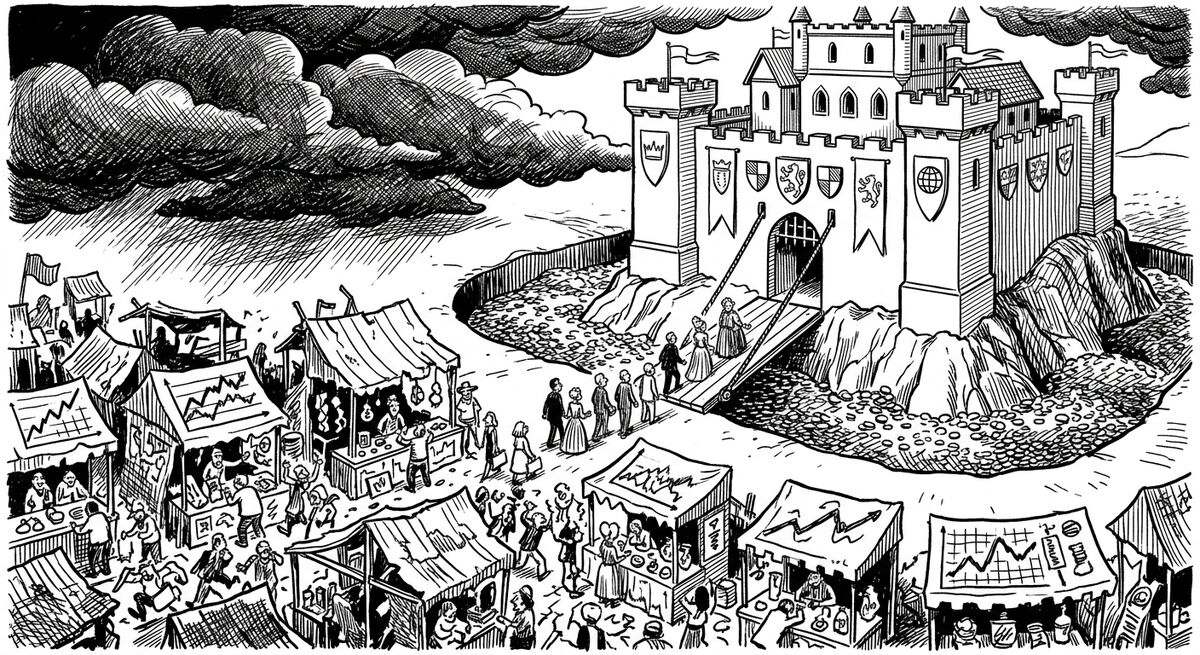
In the grand theater of the stock market, blue chip stocks are the seasoned actors, commanding the stage with their storied legacies, robust financials, and household names. Companies like $AAPL, $JNJ, and $GOOGL are often viewed as invincible, their brands etched into the fabric of our daily lives. However, behind the curtain of familiarity lies an intricate web of competitive dynamics that investors must unravel to understand the true resilience of these giants.
Market Dominance Meets Vulnerability
Blue chip companies exude market dominance, possessing the kind of financial muscle and brand loyalty that can create a seemingly impenetrable fortress. Yet, even the most formidable fortifications can be breached. The ever-looming specter of disruption is a constant threat, with innovative upstarts and shifting consumer preferences capable of toppling even the mightiest incumbents.
Take the tech sector, for example. While companies like $MSFT and $AMZN have thrived during the pandemic, their dominance is not guaranteed. The rapid evolution of technology can leave even the stalwarts vulnerable if they fail to adapt. Meanwhile, traditional sectors like banking and energy have weathered the storm differently, often relying on their robust business models and established customer bases to maintain stability.
The Importance of Evaluating Competitive Dynamics
For investors, understanding the competitive dynamics within key product categories is crucial when evaluating blue chip stocks. The pandemic served as a litmus test for various sectors, revealing how competitive advantages can manifest in varying economic conditions. While $XOM and $BAC may have faced significant headwinds, their historical market positions and established networks provided them with a buffer against the chaos.
Conversely, tech giants like $NFLX saw a surge in demand as consumers flocked to streaming services during lockdowns, showcasing how adaptability can turn potential pitfalls into golden opportunities. Thus, investors must not only consider the brand but also the competitive landscape that surrounds these companies.
Defensible Moats: The Cornerstone of Long-Term Success
This brings us to the concept of 'defensible moats.' A company's moat represents its competitive advantage — the unique characteristics that allow it to fend off rivals and sustain profitability over time. Think of it as the moat around a medieval castle, designed to keep invaders at bay. For blue chip stocks, these moats can take various forms: brand loyalty, proprietary technology, economies of scale, or regulatory barriers.
Investors should prioritize companies with strong, defensible moats, as they are more likely to thrive in the face of adversity. For instance, $PG has built a formidable moat through its extensive portfolio of trusted brands, while $V and $MA dominate the payments sector with their vast networks and partnerships. These companies can weather storms that would leave less fortified competitors scrambling.
A Sectoral Perspective: Tech vs. Banking/Energy
When examining performance across sectors during the pandemic, the contrasts become stark. The tech sector emerged as a phoenix, soaring to new heights with the help of digital transformation. Companies like $TSLA and $ADBE capitalized on shifting consumer behavior, proving that innovation and adaptability are critical in tumultuous times.
In contrast, the banking and energy sectors grappled with uncertainty, showcasing that even blue chip stocks can falter when faced with market volatility. The pandemic laid bare the vulnerabilities of $C and $WFC, reminding investors that historical performance does not guarantee future success.
Conclusion: The Need for Vigilance
In conclusion, while blue chip stocks may appear to be the bedrock of a stable portfolio, investors must remain vigilant. The inherent market dominance of these companies does not render them immune to disruption; rather, it highlights the necessity of thorough evaluation of their competitive dynamics and defensible moats. As we navigate an uncertain market environment, understanding these factors will be paramount for long-term investment success.
So, the next time you contemplate adding a blue chip stock to your portfolio, remember: it's not just about the brand name, but the fortress that surrounds it. Evaluating the strength of that fortress might just be the difference between a wise investment and a costly blunder.